




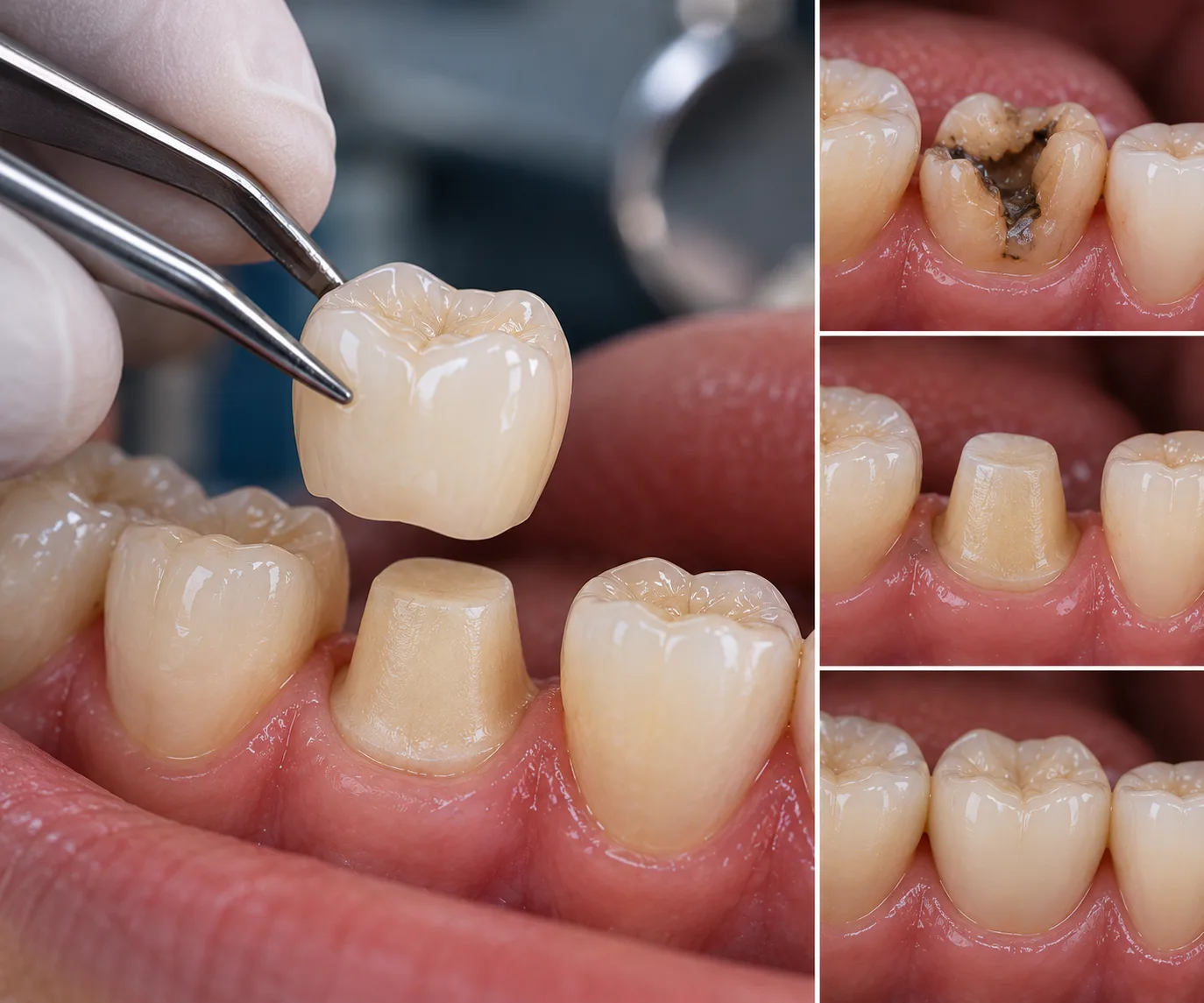
Dental Crown: Not Just Covering the Teeth, But Re-protecting and Restoring Function
Dental crown; It is a fixed restoration that surrounds the part of the natural tooth that remains in the mouth and aims to rearrange the shape, durability, function and aesthetic appearance of the tooth.
crowns; It can be evaluated in teeth that have lost significant amounts of material, have been weakened by large fillings, are broken, worn out, or need to be restructured for different restorative reasons.
However, at DentHolding Clinics, we do not automatically recommend crowns for every aesthetic problem.
The first question for us is “which crown should we make?” but “does this tooth really need a crown?” is the question.
Not Every Teeth Need to Be Crowned for a Beautiful Smile
For some teeth, a full crown may be the right option.
In some teeth, more natural tooth tissue can be preserved with bonding, veneers, inlays/onlays or more conservative restorations.
At DentHolding Clinics, our goal is not to make the most crowns possible; What you need is to determine the correct restoration.
In what situations can a dental crown be evaluated?
| Clinical Status | Why Could Krona Be on the Agenda? |
|---|---|
| Further Item Loss | The remaining structure of the tooth may need to be supported with a more extensive restoration. |
| Big Old Fillings | If the remaining natural tooth tissue is weakened, a full or partial coverage restoration may be required. |
| Broken Tooth | The tooth can be reconstructed depending on the level of the fracture and the amount of remaining healthy tissue. |
| Worn Teeth | Tooth length, bite and function may need to be rearranged. |
| Root-Treated and Weakened Tooth | A crown or different cuspal protective restoration can be considered to protect the remaining tissue, especially in the back teeth with large tissue loss. |
| Advanced Aesthetics / Form Problems | In appropriate cases where the shape of the tooth needs to be more comprehensively redesigned, the crown option may be considered. |
| Dental Bridge Support | In cases where missing teeth are completed with a classical bridge, the support teeth can be prepared in the form of crowns. |
| Tooth on Implant | The final restoration prepared on the dental implant may also be in the form of a crown over the implant. |
We Check How Strong the Tooth Is Before Making a Crown
Whether a tooth is suitable for a crown is not determined solely by how it looks from the outside.
The remaining healthy tissue of the tooth, the amount of decay, existing fillings, cracks or fractures, root structure, gum and bone support are evaluated together.
Because the crown is not a magic coating that eliminates the basic problems of the tooth it is placed on.
Just a Beautiful Crown Is Not Enough If the Tooth Under the Crown Is Not Strong
If there is active caries, periodontal problems, or a restoratively inadequate foundation, these problems must be evaluated first.
A quality crown is not just a restoration that looks beautiful on the outside; It is a restoration that is correctly prepared and applied on a healthy foundation.
Is the tooth cut while making a dental crown?
Yes. In order to create a full crown, the natural tooth must be prepared in a controlled manner.
A certain amount of tissue is removed from the tooth surfaces so that the crown can be placed.
However, the amount of preparation is not the same for every tooth.
The material to be used, existing tooth tissue, old fillings, position of the tooth, bite and the required thickness of the restoration affect the amount of preparation.
We Try to Preserve Healthy Dental Tissue as Much as Possible
When a full crown is required, it is necessary to provide sufficient space for the restoration.
However, it is not right to make more preparations than necessary.
The aim is to strike the right balance between making room for the crown and preserving the natural tooth tissue.
Is a Crown Necessary for Every Aesthetic Problem?
No.
Especially if only a color or minor form change is desired in healthy and largely intact front teeth, more conservative options can be considered instead of a full crown.
| Treatment | General Approach |
|---|---|
| Composite Bonding | It can be used with minimal intervention in suitable cases for small forms, edges, gaps or aesthetic arrangements. |
| Laminate Veneer | It may be more conservative in cases where the front surface aesthetics need to be changed and the tooth structure is suitable. |
| Onlay / Overlay | It can help protect the damaged area and chewing surfaces without requiring a full crown, especially on the back teeth. |
| Full Crown | It is evaluated in teeth with more extensive tissue loss, structural weakness, or requiring complete circumferential restoration. |
It's Not Important to Make a Crown, It's Important to Choose the Right Treatment
If natural tooth tissue can be safely preserved with a more conservative treatment, we evaluate these options first.
Does Every Teeth Having Root Canal Treatment Require a Crown?
No.
Not every root canal treated tooth needs to be crowned automatically.
Final restoration decision; It is determined according to the remaining healthy tooth tissue, whether the tooth is in the front or back area, existing cracks, chewing forces and the size of the restoration.
Restorations that protect chewing surfaces, such as crowns or onlays/overlays, may be evaluated more frequently, especially in posterior teeth with large material loss.
We Do Not Make Automatic Crowns Just Because There Is Root Canal Treatment
We choose the restoration not according to the name of the root canal treatment, but according to the remaining tooth tissue.
Is Root Canal Treatment Required for a Tooth Where a Crown Will Be Made?
Making a crown does not automatically mean that a root canal treatment will be performed on a healthy and vibrant tooth.
Root canal treatment is only considered in teeth where the pulp is irreversibly damaged, infected, or requires endodontic treatment for different clinical reasons.
At DentHolding Clinics, we do not find it right to perform routine and unnecessary root canal treatment just because a crown will be made.
What Materials Can Dental Crowns Be Made Of?
The crown material does not have to be the same for every patient and every tooth.
The area where the restoration is located, remaining tooth tissue, chewing forces, aesthetic expectation, tooth color and closing material are important in choosing.
| Crown Type | General Feature |
|---|---|
| Zirconium Chron | It is one of the restorative options that does not contain metal and targets durability and aesthetics together. |
| Full Ceramic Crown | It can be evaluated especially in selected cases where the aesthetic requirement is high. |
| Lithium Disilicate / Ceramic Systems | In suitable cases, it can offer aesthetic restoration options close to natural light properties. |
| Metal Supported Ceramic Crown | It is a different crown option that has been used for a long time; It can be evaluated according to the case and need. |
The Quality of the Crown Is Not Only Determined by the Name of the Material
Just because it says “zirconium” or “ceramic” does not mean a good crown.
Correct indication, correct tooth preparation, correct laboratory, correct marginal fit, correct contacts, correct bite and gingival harmony are important together.
Materials are only part of a good treatment system.
Can a Dental Crown Look Natural?
A correctly planned crown can be prepared in a natural-looking and compatible way with the surrounding natural teeth.
However, a natural look is not just about choosing color.
The tooth's form, length, width, surface structure, light transmission and reflection properties, gum line and its relationship with neighboring teeth should be evaluated together.
Natural Look = Not Just White Teeth
Some patients want a more natural and soft color.
Some patients prefer a more prominent, bright and “Hollywood” aesthetic.
We plan the color, form and smile character together with your face and expectations.
Should Teeth Whitening Be Done Before Crown Treatment?
If you want to lighten the color of your natural teeth, it may be better for some patients to have the whitening process done before the final crown color is determined.
Because porcelain, ceramic or zirconium crowns are not whitened like natural tooth enamel.
Whitening natural teeth after the final restoration has been made may cause color mismatching.
First Determine Your Natural Teeth Tone. Then Plan Your Crown Color.
If whitening is considered, restorative treatment timing and final color selection should be planned by your dentist.
Is Dental Crown Treatment Painful?
Preparation of the natural tooth for the crown is most often carried out under local anesthesia.
By anesthetizing the treatment area, it is aimed to avoid feeling any pain during the procedure.
After preparation, temporary hot-cold sensitivity or gum sensitivity may occur in living teeth.
The level of sensitivity may vary depending on the initial condition of the tooth and the extent of the treatment.
Will I Remain Toothless Until the Final Crown is Prepared?
In appropriate cases, temporary crowns can be applied to the prepared teeth to be used until the final crowns are completed.
Temporary crowns help protect the prepared tooth, reduce sensitivity and support the aesthetic appearance during treatment.
However, the material and purpose of temporary crowns are different from the final restoration.
Temporary Teeth → Try-In → Final Crown
While preparing the final crown, we aim to keep the patient as comfortable and functional as possible during the treatment process.
How Long Do You Need to Stay in Türkiye for a Dental Crown?
Crown treatments, which do not require surgery and are applied only to natural teeth, can often be completed in a single visit to Türkiye for suitable patients.
Dental Crown Treatment Plan
1 Türkiye Visit in Most Eligible Cases
About 5–7 Days
Examination → Treatment decision → Tooth preparation → Digital recording / measurement → Temporary crowns → Laboratory → Rehearsals → Final crowns → Closing → Aftercare
Treatment duration may vary depending on the number of crowns, initial condition of the teeth, required root canal or periodontal treatments, and laboratory process.
For implant-supported crowns, a different visit plan may be required due to the surgical and biological healing stages of the implant.
Are a Dental Crown and an Implant Crown the Same Thing?
In the finale, both may be a restoration of dental appearance; but their support structures are different.
| Feature | Natural Tooth Crown | Implant Top Crown |
|---|---|---|
| Support | Natural tooth | Dental implant |
| Tooth Preparation | Natural tooth is prepared. | The adjacent natural tooth does not need to be prepared. |
| Surgery | The crown itself does not require implant surgery. | Prior implant surgery is required. |
| Maintenance | Cleaning of natural teeth and crown edges is important. | Gum and prosthesis care around the implant is important. |
Why is the Compatibility of the Crown with the Gum Important?
The edge area where the crown meets the gum is important for both aesthetics and long-term care.
Restoration edges must be positioned appropriately, surfaces must be cleanable, and the patient must be able to maintain plaque control.
If there is bleeding gums, active periodontal disease or dense plaque, gum health may need to be evaluated before starting aesthetic crown treatment.
A Beautiful Crown Starts with a Healthy Gum Line
We look for the aesthetics of the restoration not only in the color of the tooth, but also in the harmony between the tooth and the gum.
Can the Natural Tooth Under the Crown Decay?
Yes.
A natural tooth with a crown does not become completely immune to decay.
Plaque accumulation, especially on the crown edges, inadequate oral hygiene or restoration-related problems may contribute to the formation of new caries over time.
Therefore, the application of the final crown does not eliminate the importance of daily oral care.
What are the Risks and Limits of a Dental Crown?
As with any restorative treatment, crown treatment has possible risks and long-term care requirements.
| Possible Situation | What Does It Mean? |
|---|---|
| Temporary Sensitivity | Temporary hot and cold sensitivity may occur in living teeth after treatment. |
| Pulpal Problem | Pulp damage may develop in some teeth over time and root canal treatment may be required. |
| Secondary Caries | New decay may develop in the natural tooth at the edge of the crown. |
| Gum Problems | Inflammation may occur around poor hygiene or improper restoration. |
| Crown Fracture / Crack | Mechanical damage may occur due to high force, trauma or material properties. |
| Loosening of the Crown | The crown may move over time due to reasons related to the connection or support tooth. |
| Bruxism | Teeth clenching and grinding can create high mechanical loads on the crown and natural teeth. |
We Don't Just Tell You About the Aesthetic Result
We also explain the limits of crown treatment, the condition of the natural tooth, and the need for long-term care as part of the treatment plan.
How Much is a Dental Crown Used?
There is no fixed usage period for a crown that is valid for all patients.
Long-term result of the crown;
- remaining natural tooth tissue,
- to fit the crown,
- based on the restorative material used,
- to closing and chewing forces,
- bruxisme,
- hygiene on the crown edges,
- for gum health,
- routine checks
It depends.
Properly planned and well-maintained crowns can be used for many years; However, it is not correct to guarantee lifetime clinical success.
DentHolding Gum Care & Aftercare Protocol – Dental Crown
In crown treatment, we aim to protect not only the restoration itself, but also the natural tooth and gum around the crown.
Because no matter how high quality the crown is, plaque accumulated on the edges of the crown can affect the natural tooth and gum tissues.
That's why, when your final crowns are completed, we want you to know not only your new smile, but also how to protect it.
| phase | DentHolding Approach |
|---|---|
| 1. Tooth & Gum Check | The health of the tooth on which the crown will be applied, supporting tissues and gums are evaluated. |
| 2. Clinical Gum Care | The need for professional cleaning or periodontal care is evaluated before treatment. |
| 3. Crown Care Training | How to clean the crown edges and between the teeth is explained individually. |
| 4. Personal Home Care | Brushing and interdental care routine is planned according to the patient's restorations. |
| 5. Bite & Restoration Follow-Up | The need for control of the bite, crown surfaces and restorations is evaluated. |
| 6. DentHolding Aftercare | When necessary, post-treatment information and remote communication support is provided for international patients. |
Along with Your New Crown, Know How to Protect It
Maintaining the natural tooth and gum health around the crown is an important part of the long-term care of the restoration.
Clinical Care → Crown Care → Personal Guidance → Home Care → Healthier Smile
Healthy Gums. BetterCare. A Healthier Smile.
Your Dental Crown Treatment Journey
| 1. Online Pre-Assessment | Your current teeth/smile photographs and existing dental X-ray images can be shared for preliminary evaluation. |
| 2. Clinical Assessment | It is evaluated whether the tooth really needs a crown and more conservative alternatives. |
| 3. Treatment & Smile Planning | Material, tooth form, color, closure and aesthetic plan are determined. |
| 4. Tooth Preparation | The necessary tooth preparation for the crown is carried out in a controlled manner. |
| 5. Temporary Crowns | In appropriate cases, temporary crowns are prepared for use in the laboratory phase. |
| 6. Laboratory & Try-In | Crowns are prepared; Colour, form, fit, contacts and closure are evaluated. |
| 7. Final Crowns | After the necessary checks, final crowns are applied. |
| 8. Gum Care & Aftercare | The personal care system of crown edges, interdental spaces and restorations is explained. |
Why DentHolding Clinics?
Not More Crowns. The Right Crowns.
We plan the treatment you need, not the number of crowns.
At DentHolding Clinics, we do not see dental crown treatment as simply shrinking teeth and placing new restorations on them.
Preservability of the existing natural tooth tissue, the question of whether a crown is really necessary, alternatives such as bonding or veneers, the need for root canal treatment, material selection, gum health, aesthetics, closure, laboratory quality, cleanability and DentHolding Gum Care & Aftercare Protocol are parts of the same treatment plan.
Our goal is not to make you crowns; is choosing the right restoration for your natural teeth.
Does Your Tooth Really Need a Crown?
Send Us Your Current Dental Photographs and Dental X-Ray Images You Have.
Are crowns necessary?
Could veneering or bonding be more conservative?
Is root canal treatment needed?
Is zirconium or a different ceramic more suitable?
How many crowns are really needed?
How many days should you stay in Türkiye?
Let's start your first evaluation before you come to Türkiye.
Preserve What You Can. Restore What You Need.
Notification: Online evaluation is for preliminary information purposes and does not replace clinical examination and necessary dental radiological evaluations. Not every aesthetic or structural problem requires a full crown. The natural tooth must be prepared in a controlled manner for the dental crown. The amount of preparation varies depending on the initial condition of the tooth and the restoration system to be used. Root canal treatment is not required for every tooth to be crowned. It is not mandatory for every root canal treated tooth to be crowned automatically. The final restoration is determined according to the remaining tooth tissue, tooth position, bite and restorative needs. Suitable natural tooth crown cases that do not require surgery can often be completed in a single visit to Türkiye and within approximately 5–7 days; Duration may vary depending on the number of crowns, additional treatments required and laboratory process. Restorative materials cannot be whitened like natural teeth; If teeth whitening is considered, the treatment sequence should be determined by the physician. Secondary caries, periodontal problems or pulp problems may develop over time in natural teeth with crowns. The duration of use of crowns varies from person to person and lifetime clinical success cannot be guaranteed. The definitive treatment plan is created after clinical examination and necessary evaluations.
- Personalized planning
- Digital assessment
- Natural appearance-oriented approach