




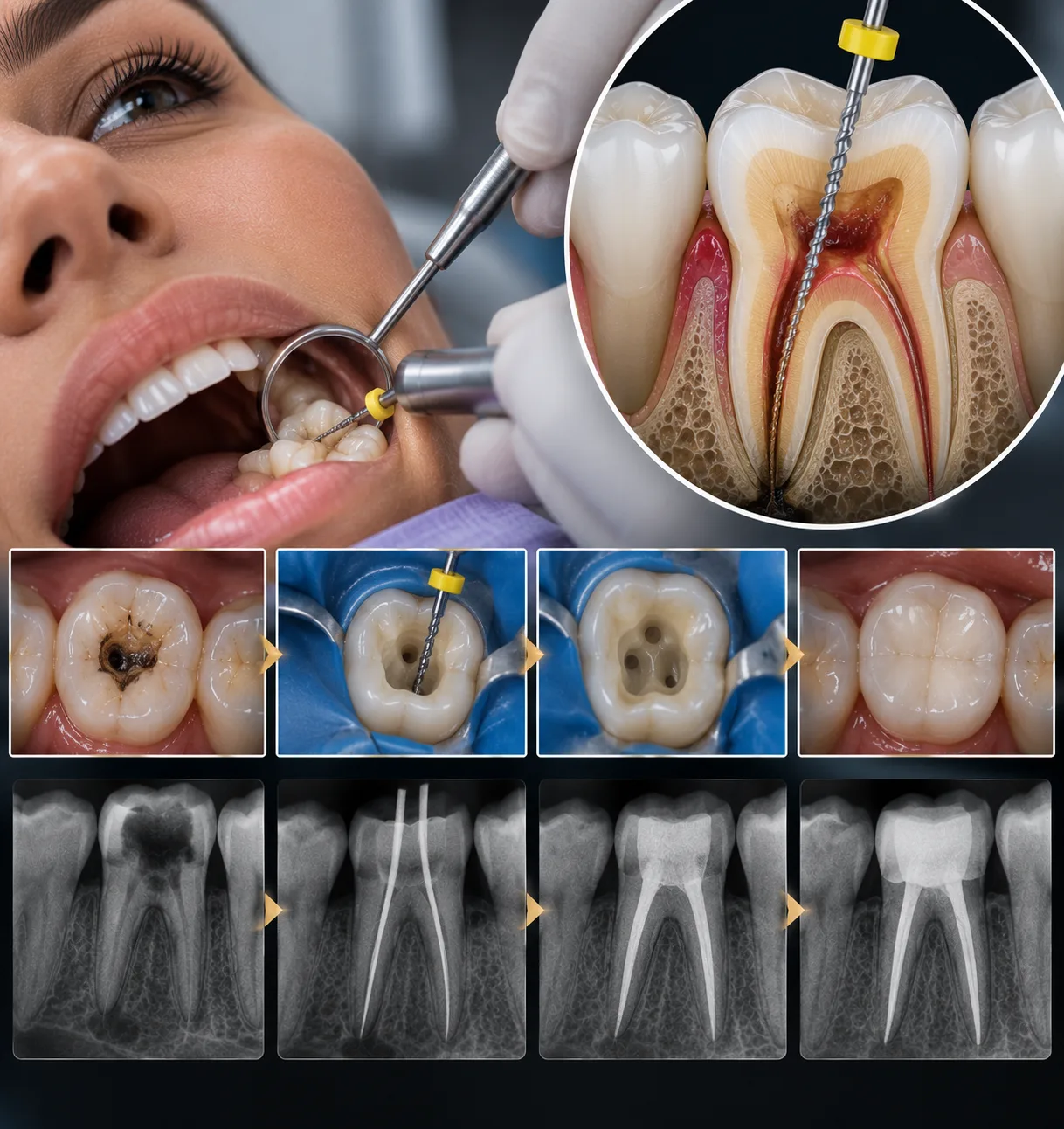
Root Treatment: We Try to Protect Your Own Tooth Instead of Extracting the Tooth
Inside the tooth, there is a living structure called pulpa, which contains nerve and vascular tissues.
This tissue may become irreversibly damaged or infected due to deep caries, trauma, cracks, old large fillings or other reasons.
In this case, the goal is not always to extract the tooth.
Root treatment is the removal of infected or damaged tissue from the inside of the tooth in appropriate cases and trying to keep the natural tooth in the mouth.
We Evaluate the Chance of Preserving the Tooth Before It Loses
If a tooth can be preserved safely and functionally with root canal treatment, preserving the natural tooth is an important treatment option.
However, not every problematic tooth can be saved with root canal treatment.
At DentHolding Clinics, our aim is not to perform root canal treatment on the patient; is to answer the question: can teeth really be protected?.
Why May Root Canal Treatment Be Required?
In some cases, the pulp tissue within the tooth may be damaged to a level that it cannot heal itself.
| Status | Why Can Root Canal Treatment Be on the Agenda? |
|---|---|
| Deep Caries | Once the decay reaches the pulp tissue, irreversible inflammation or infection may develop. |
| Severe/Long Lasting Toothache | Long-lasting pain, especially after hot or cold exposure, may be one of the signs of pulp damage. |
| Loss of Vitality of the Dental Nerve | When pulp necrosis develops, infection in the root canal system may occur. |
| Root Tip Infection / Lesion | Infected canal system may cause inflammation in the surrounding tissues at the root tip. |
| Tooth Trauma | After impact, the pulp may lose its vitality or become damaged over time. |
| Cracked or Broken Tooth | Root canal treatment can be evaluated according to the depth of the crack and its relationship with the pulp. |
| Eold Major Restorations | Irreversible damage to the pulp tissue may develop over time. |
How Do We Know If Root Canal Treatment Is Required?
Not every toothache requires root canal treatment.
Likewise, the absence of pain does not mean that the tooth is completely healthy.
Some infected teeth can progress for a long time without causing significant pain.
Therefore, the decision for root canal treatment is not made solely based on the patient's pain description.
Know First. Then Root Canal Treatment.
Clinical examination, restorative condition of the tooth, sensitivity tests and necessary dental X-ray images are evaluated together.
What is important for us is not "tooth hurts, let's do a root canal"; is to correctly identify the source of the pain.
You Can Send Your X-Ray Image Before Coming to Turkey
Our international patients can share their existing dental X-ray or panoramic x-ray images with the DentHolding Clinics team.
These images;
- status of current root canal treatment,
- possible lesions at the root tip,
- deep bruises,
- existing crowns or fillings,
- general restorative condition of the tooth
It can help with the initial evaluation before coming to Türkiye.
However, a definitive diagnosis requires clinical examination and necessary dental imaging.
Not Every Black Area Means "Tooth Will Be Extracted"
Some lesions seen at the root tip on x-ray may improve after appropriate root canal treatment or, in necessary cases, renewal of root canal treatment.
We do not make the decision to extract a tooth based solely on the size of the image on the x-ray; We evaluate the entire tooth.
How is Root Canal Treatment Done?
The purpose of root canal treatment is to remove infected or damaged tissues in the root canal system, reduce the microorganism load and fill the canals with a suitable material.
| phase | What to Do? |
|---|---|
| 1. Diagnosis and Planning | The tooth's need for root canal treatment and its maintainability are evaluated. |
| 2. Local Anesthesia | Patient comfort is ensured by anesthetizing the treatment area. |
| 3. Access to Duct System | Controlled entry into the root canals is provided from inside the tooth. |
| 4. Cleansing and Styling | Damaged pulp tissue is removed and the root canals are cleaned by mechanical/chemical methods. |
| 5. Disinfection | It is aimed to reduce the microorganism load in the root canal system. |
| 6. Channel Filler | The prepared root canals are filled with appropriate canal filling materials. |
| 7. Upper Restoration of the Tooth | Depending on the remaining healthy tissue of the tooth, the appropriate final restoration such as filling, onlay or crown is planned. |
The Success of Root Canal Treatment Doesn't Just End Inside the Canal
After the root canal treatment is completed, it is very important to restore the upper part of the tooth in the mouth correctly.
Good root canal treatment + correct final restoration + correct oral care should be considered together.
Is Root Canal Treatment Painful?
Root canal treatment is usually performed under local anesthesia.
By adequately anesthetizing the treatment area, the aim is for the patient not to feel pain during the procedure.
In some teeth with advanced inflammation or infection, the anesthesia and treatment process can be managed more precisely.
After treatment, sensitivity or discomfort may occur for a few days, especially when pressing on the tooth.
The duration and severity of this condition may vary depending on the infection status of the tooth before treatment, the scope of the procedure and the person's recovery.
The Purpose of Root Canal Treatment is Not to Create Pain, but to Treat the Source of Pain
We aim to manage the process as comfortably as possible with controlled local anesthesia, accurate diagnosis and planned treatment.
Does Root Canal Treatment Complete in One Session?
Some root canal treatments can be completed in a single session.
However, the canal anatomy and infection status of each tooth is not the same.
If there is intense infection in the root canal, discharge, advanced root tip lesion, complicated canal anatomy or the need for re-canal treatment, the treatment may need to be divided into two or more sessions.
| Clinical Status | General Approach |
|---|---|
| Uncomplicated Convenient Case | It can be completed in a single session under suitable conditions. |
| Active / Heavy Infection | More than one session may be required due to additional disinfection and intermediate medication. |
| Complex Root Canal Anatomy | The extent and duration of treatment may increase. |
| Root Treatment Renewal | More sessions may be required due to removal of old root canal material and re-cleaning of the canals. |
How Long Do You Need to Stay in Türkiye for Root Canal Treatment?
Root canal treatment is among the treatments that do not require a long Türkiye program in terms of health tourism.
In a suitable and uncomplicated case, the root canal treatment itself can be completed on the same day or within a short treatment program.
However, if a final restoration, onlay or crown will be applied to the tooth after root canal treatment, the treatment period is planned accordingly.
Root Canal Treatment Travel Plan
1 Türkiye Visit in Most Eligible Cases
Root Treatment Only
Same day or approximately 1-2 days in suitable cases
Root Treatment + Final Restoration / Crown
Depending on the type of restoration and laboratory needs, a more comprehensive program of several days may be required.
Complex infection or retreatment:
Additional sessions or different timing may be required.
Does Every Teeth Having Root Canal Treatment Require a Crown?
No.
It is not right to automatically apply a crown to every tooth that has had root canal treatment.
The final restoration is determined according to how much solid tissue remains in the tooth, the position of the tooth in the mouth, existing restorations, risk of cracks and the chewing forces on it.
Especially in the back teeth with large material loss, onlay or crown-like cuspal protective restorations can be considered to help protect the remaining tissue of the tooth.
If there is sufficient healthy tooth tissue in the anterior region, more conservative restorations may be appropriate.
We Treat the Root Canal and Do Not Forget the Top of the Tooth
Leaving an inadequate or leaky restoration on the tooth after root canal treatment may negatively affect the long-term result.
Therefore, we see root canal treatment and final restoration as parts of the same treatment plan.
Does a Root Canal Treated Tooth Become More Fragile?
The risk of fracture of a root canal treated tooth cannot be explained simply because "the nerve has been removed".
Many of these teeth already have deep decay, large fillings, or significant loss of dental tissue before they undergo root canal treatment.
Therefore, the amount of remaining tooth tissue and the design of the final restoration are important in assessing the risk of fracture.
Protection of the remaining tissue due to high chewing forces, especially in the back teeth, is also planned.
Can a tooth with root canal treatment become infected again?
Yes.
Even after a successfully completed root canal treatment, re-infection may occur over the years for different reasons.
Possible reasons for this include;
- overlooked canal anatomy,
- insufficient channel disinfection,
- problems in channel filling,
- leakage from the upper restoration of the tooth,
- new rot,
- cracked or broken
can be found.
If Old Root Canal Treatment Failed, Do We Have to Extract the Tooth Immediately?
Not always.
If the tooth can be preserved restoratively and clinical conditions are suitable, root canal treatment can be evaluated.
In some selected cases, different endodontic options such as root end surgery may also be considered.
It is important to decide whether the tooth will be extracted or not after re-treatment options are evaluated.
What is Root Canal Renewal?
The process of re-cleaning and filling the root canal system by removing the existing canal filling materials in a tooth where root canal treatment has been previously performed but the infection continues or develops again is called root canal treatment renewal / retreatment.
Retreatment may be more complex than the initial root canal treatment.
Old canal materials, post applications, existing crowns and root canal anatomy may affect the difficulty of treatment.
Does the Lesion at the Root Tip Disappear Immediately After Root Canal Treatment?
No.
Healing of bone lesions at the root tip is a biological process and it may take time to see radiographic improvement.
The lesion on the x-ray is not expected to disappear immediately after root canal treatment.
In suitable cases, recovery is followed within months.
Treatment is Done Today. Bone May Take Time to Heal.
We evaluate the healing at the root tip not only by the relief of pain, but also through clinical and radiological checks when necessary.
Are Antibiotics Required in Root Canal Treatment?
It is not necessary to use antibiotics in every root canal treatment.
The main treatment for localized root canal infection is to dentally control the source of infection.
Need for antibiotics; It is evaluated by the dentist according to the spread of the infection, swelling, fever, general health condition and clinical findings.
Antibiotics Are Not a Replacement for Root Canal Treatment
We care about treating the source of the infection correctly instead of using antibiotics even though it is not necessary.
Can the Color of the Tooth Change After Root Canal Treatment?
Color change may occur over time in some root canal treated teeth.
The restorative state of the tooth is evaluated if it causes aesthetic discomfort, especially in the front area.
In appropriate cases, internal whitening or different aesthetic restoration options can be considered.
A direct crown or veneer is not required for every color change.
How long is a tooth treated with root canal treatment used?
It is not right to guarantee a fixed period of use or lifetime success for a root canal-treated tooth that can be applied to all patients.
Long term result;
- root canal anatomy, ZXQDHTAG00478QXInitial state of infection,
- to the quality of root canal treatment,
- to the remaining intact tooth tissue,
- final restoration,
- chewing forces,
- oral hygiene
It depends on many factors such as.
A properly treated and correctly restored tooth can function for many years; However, the exact duration cannot be guaranteed on an individual basis.
Our goal is not only to relieve the pain, but also to make the tooth usable for the long term.
Correct root canal treatment → correct final restoration → correct care.
DentHolding Gum Care & Aftercare Protocol – Root Canal Treatment
Root canal treatment treats the inside of the tooth; However, that tooth continues to live in the mouth with the gums, surrounding bone and neighboring teeth.
For this reason, we do not consider root canal treatment to be completed only by filling the root canal.
The final restoration of the tooth, gum environment, oral hygiene and daily care are evaluated together.
| phase | DentHolding Approach |
|---|---|
| 1. Tooth & Gum Check | The treated tooth, surrounding gums and general oral hygiene are evaluated. |
| 2. Clinical Gum Care | The necessary periodontal care and professional cleaning needs are evaluated. |
| 3. Restoration Care | How to protect the filling, onlay or crown restoration of the root canal treated tooth is explained. |
| 4. Personal Home Care | Brushing and interdental care routine is tailored to the patient. |
| 5. Follow-Up | In necessary cases, the need for clinical and radiological follow-up is determined. |
| 6. DentHolding Aftercare | Post-treatment information and communication support is provided for international patients when necessary. |
We Protected Your Own Teeth. Now Know How to Protect It.
After root canal treatment is completed, protecting the final restoration of the tooth, surrounding gums and daily oral hygiene are important parts of long-term care.
Natural Tooth → Root Canal Care → Final Restoration → Home Care → Healthier Smile
Your Root Canal Treatment Journey
| 1. Online Pre-Assessment | Dental X-ray and oral photographs you have can be shared for preliminary evaluation. |
| 2. Clinical Diagnosis | It is evaluated whether the tooth really needs root canal treatment and whether it can be preserved. |
| 3. Root Canal Treatment | The ductwork is cleaned, disinfected, and filled appropriately. |
| 4. Restorative Assessment | The need for a filling, onlay or crown is evaluated according to the remaining structure of the tooth. |
| 5. Final Restoration | The final restoration is applied to support the function and seal of the tooth. |
| 6. Gum Care & Aftercare | The daily care system of the treated tooth and surrounding tissues is explained to the patient. |
Why DentHolding Clinics?
Save the Tooth When It Can Be Saved.
The aim is not to perform root canal treatment; If possible, it is to preserve your natural teeth.
At DentHolding Clinics, we do not consider root canal treatment as a technical procedure in which only the nerve inside the tooth is removed.
Correct diagnosis, preservation of the tooth, treatment of the canal system, final restoration, closure, gum health and long-term care are parts of the same plan.
Some teeth can be preserved with a simple restoration.
Some require root canal treatment.
Some old root canal treated teeth can be retreated.
For some teeth, extraction may be a better option due to cracks, advanced tissue loss or other reasons.
For us, the goal is not to perform a specific procedure, but to make the right decision for your natural tooth.
Does Your Tooth Really Need Root Canal Treatment?
Send Us Your Dental X-Ray Image.
Can teeth be preserved?
Is root canal treatment required?
Can old root canal treatment be renewed?
Do I need a filling, onlay or crown after the canal?
How long might you need to stay when you come to Türkiye?
Let's start your first evaluation before you come to Türkiye.
Save Your Natural Tooth Whenever Possible.
Notification: Online evaluation is for preliminary information purposes and does not replace clinical examination and necessary dental radiological evaluations. Not every toothache requires root canal treatment, and the absence of pain does not mean there is no infection. Suitability for root canal treatment is determined by evaluating the pulp and periapical status of the tooth, remaining tooth tissue, periodontal support, root structure and restorative preservation. In some suitable cases, root canal treatment can be completed in a single session; More than one session may be required due to the status of the infection, canal anatomy, or the need for re-canal treatment. It is not necessary to crown every root canal treated tooth; The final restoration is determined according to the remaining tooth tissue and functional requirements. Temporary sensitivity may occur for a few days after root canal treatment. Antibiotics are not necessary in every root canal treatment and do not replace the treatment of the source of infection in the root canal alone. Radiological healing of root tip lesions may take time. Lifetime clinical success cannot be guaranteed regarding the duration of root canal treatment or the treated tooth. The definitive treatment plan is created after clinical examination and necessary evaluations.
- Personalized planning
- Digital assessment
- Natural appearance-oriented approach